Magnolia grandiflora
Southern Magnolia
General Info
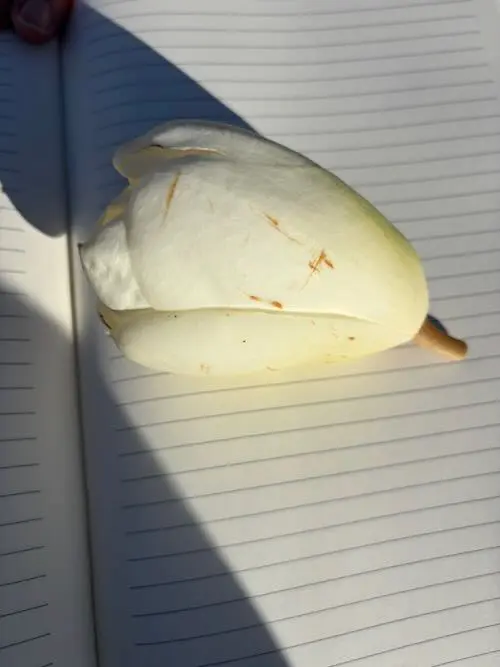
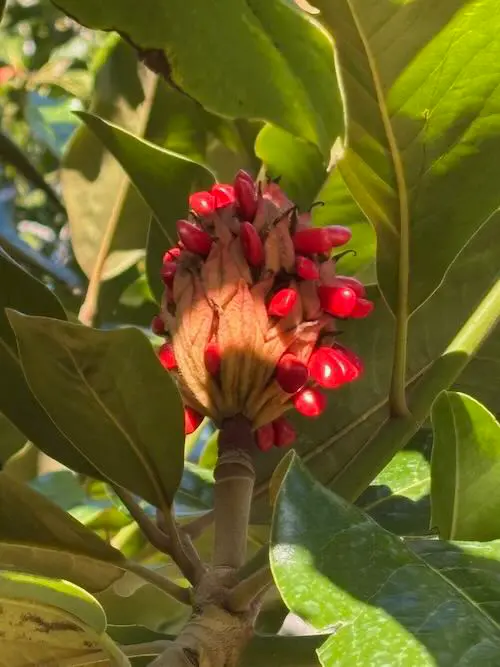
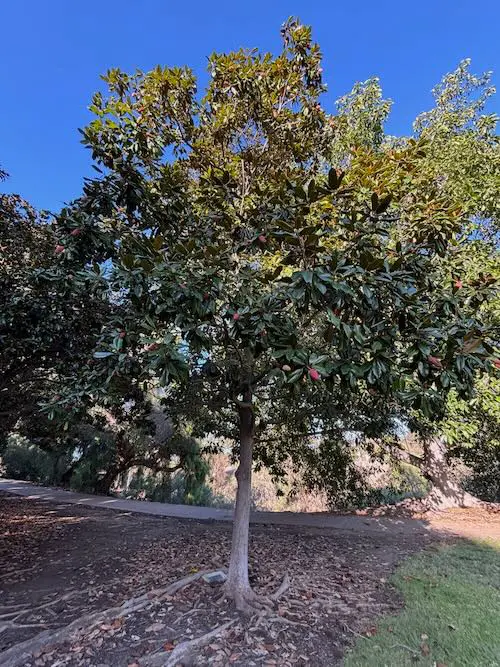
Magnolias are an ancient and primitive group of flowering plants that evolved at a time when Earth was covered primarily with ferns and conifers. The iconic southern magnolia is widely planted throughout California and is the most widely grown ornamental tree on Earth. It can be recognized by the contrasting sides on its evergreen, stiff, leathery leaves: glossy, dark green above and gray to rust-colored and felted below. Its spectacular, fruit-scented, creamy white flowers are borne individually on the deep-green canopy like huge water lilies. They are California’s largest cultivated tree flowers, some reaching a foot in diameter. These flowers evolved prior to butterflies and bees and were originally pollinated by beetles and other ancient insects. Pollinated flowers mature into aggregate cone-like clusters of small fruits, each splitting to unveil a fleshy, scarlet seed.
Native Range: Southeastern United States
Ethnobotanical Info / Tree Use: The soft, light wood of Southern Magnolia is commonly used for veneer, furniture and paper pulp. In traditional medicine, the leaves, fruits, bark, and wood are used to treat circulatory system disorders.
Tree Shape: Pyramid or Rounded
Foliage Type: Evergreen
Maximum Tree Height: 80 feet
Canopy Width: null60feet
Leaf Arrangement and Form: Alternate and Simple
Leaf Shape: Oval
Leaf Color: Dark Green
Fall Color: No
Flowers: Showy, Fragrant
Flower Color: White or Cream
Flower Time: Spring, Fall or Summer
Fruit Size and Color: Large Red, Brown Follicle
Fruiting Time: Fall or Summer
Fruit Value: Wildlife use it
Bark Color: Grey
Bark Texture: Fissured and Scaly
Litter Type: Dry Fruit, Leaves and Flowers
Water Use Rating: Medium
Sunset Climate Zone: 4 – 12, 14 – 24, H1 and H2
Soil Texture: Clay, Loam or Sand
Soil pH: Very Acidic to Slightly Alkaline
Salt Tolerance: Moderate
Schoolyard Trees: No
Shade Tolerance: No
Root Damage Potential: 0
Wildlife Interactions: Attracts Mammals, Squirrels and Birds
Disease and Pest Susceptibility: Black Mildew, Leaf Spot, Armillaria, Verticillium, Root Rot, Aphids, Invasive Shot Hole Borer, Spider Mites and Scales
Utility Friendly: No